The Future of Targeted Treatment? (2025)
The landscape of modern medicine is shifting. We are moving away from broad-spectrum “one-size-fits-all” drugs and toward a future defined by precision, specificity, and biological harmony. At the heart of this revolution is Peptide Therapy.
As we progress through 2025, a landmark article from News-Medical.net titled “Peptide Therapy: The Future of Targeted Treatment?” highlights why these small but mighty amino acid chains are being hailed as the next great frontier in healthcare.
What Makes Peptides the “Ultimate” Messengers?
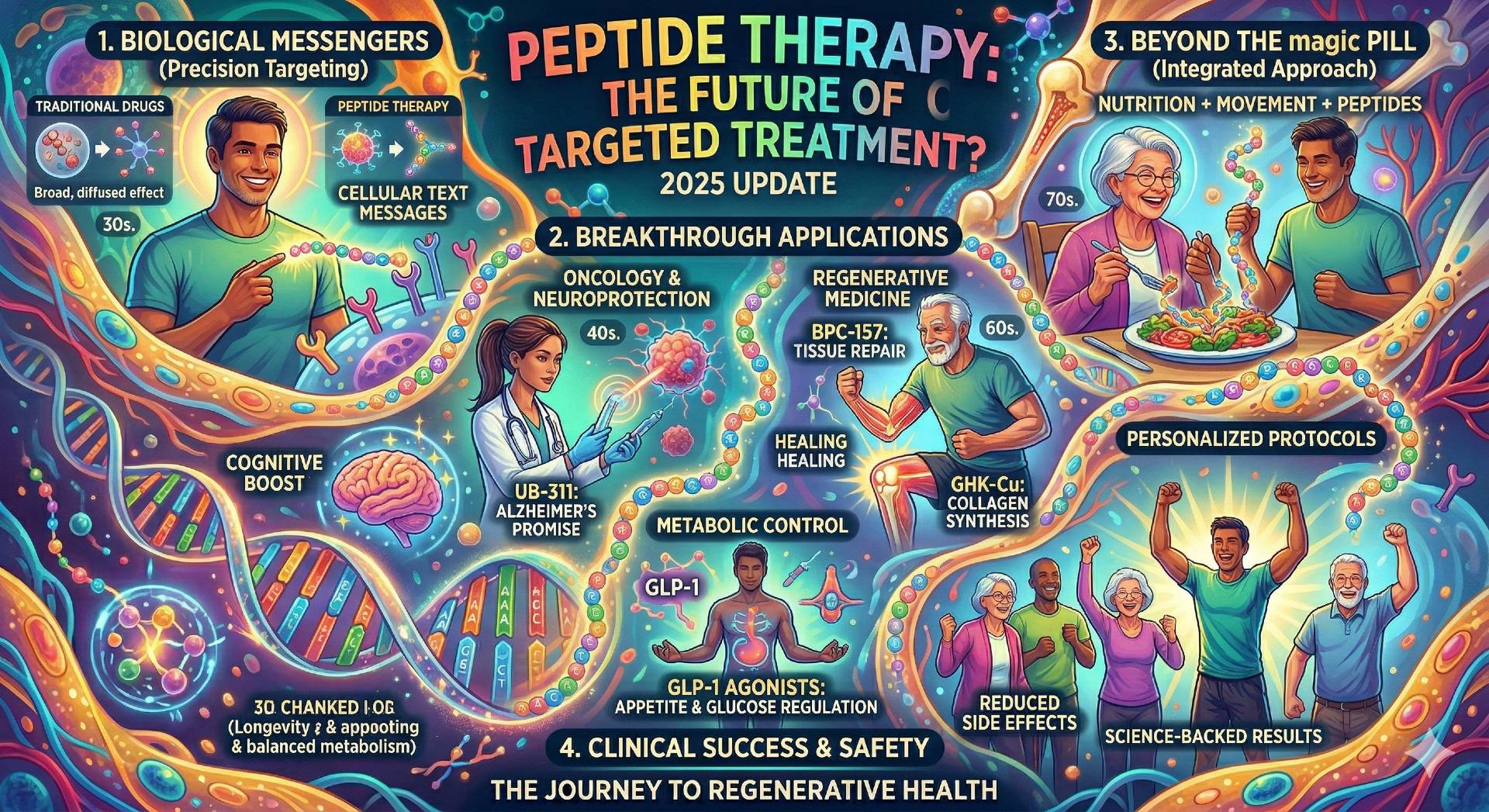
According to the 2025 report, peptides are essentially “short-chain amino acids that occur naturally in the body,” acting as high-speed signaling molecules (News-Medical, 2025). Think of them as biological text messages. They tell your cells exactly what to do—whether that’s “heal this tendon,” “burn this fat,” or “produce more collagen.”
The magic lies in their high specificity. Unlike traditional small-molecule drugs that can cause systemic side effects, peptides bind to specific receptors with “both high specificity and affinity,” triggering intracellular effects while leaving healthy cells untouched (News-Medical, 2025).
3 Breakthrough Frontiers in 2025
1. The End of “Undruggable” Diseases
For years, many biological targets were considered “undruggable” because traditional medicines couldn’t reach them. The 2025 review points out that peptides “uniquely bridge the gap between small molecules and biologics” (News-Medical, 2025). Their programmable architecture allows them to modulate protein-protein interactions that were previously out of reach.
2. Personalized Oncology & Neuroprotection
The future of cancer treatment may be paved with peptides. The article notes that researchers are now using “peptide-based imaging probes” to visualize tumors with pinpoint accuracy. Even more exciting is the development of peptide vaccines like UB-311, which showed promise in stimulating cognitive improvements in patients with early-stage Alzheimer’s (News-Medical, 2025).
3. Regenerative Medicine: Beyond Symptom Management
Perhaps the most “viral” aspect of peptide therapy in 2025 is its role in recovery. Peptides like BPC-157 and GHK-Cu are no longer just for “biohackers.” The research highlights their ability to:
- Promote Angiogenesis: Creating new blood vessels to deliver nutrients to damaged tissue.
- Accelerate Wound Healing: Supporting proper tissue repair at the cellular level.
- Reduce Inflammation: Lowering inflammatory markers like TNF-alpha (News-Medical, 2025).
A Science-Backed Path Forward
While the enthusiasm is high, the 2025 report emphasizes a “mature understanding.” We have moved from “one-size-fits-all” to precision protocols. The most successful outcomes in 2025 come from integrated programs where peptides are used alongside nutrition and movement, rather than as a “magic pill” replacement (News-Medical, 2025).
As we look toward 2026, the message is clear: Peptides are not just the future of medicine—they are the present. They represent a shift toward a medical model that is regenerative, preventative, and deeply respectful of the body’s natural intelligence.
Source Reference:
News-Medical.net (2025). “Peptide Therapy: The Future of Targeted Treatment?” Health & Medical News. [Updated May/June 2025]